


Search Website
When Movement Returns: Restoring Dignity and Hope in Northern Malawi
Christa Roby, Master’s Student, Global Health Equity, Western University
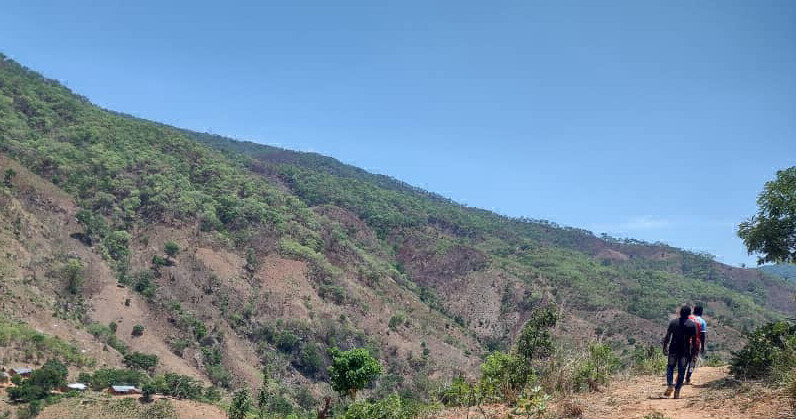
Deep in the remote hills of Northern Malawi sit two elder siblings; the sister, 89 years old, and the brother, 92. Both have spent their entire lives in this quiet mountain village. She is married and has fulfilled her lifelong duties as a wife and mother. Bearing four children, she cared for the home and tended to their needs with devotion. Her brother worked as a fisherman-trader, spending his days hiking down one side of the mountain to meet fishermen at the lake and climbing the other to sell fish in the valley trading centres.
Their love for traditional life is steadfast, yet it has come with limitations. In Malawi, 91.6% of older people live in rural areas (Malawi National Statistical Office, 2018). Their village has never seen support from government health services, although rural areas are intended to have health assistants every eight kilometres (Malawi24, 2020). When health needs arose, the only option was to hike 17 kilometres to the nearest health post. For more complex cases or services such as physiotherapy, families would hire transport to the District Hospital, a journey of 68 kilometres that involves walking, riding on a motorbike, and finally taking a local taxi from the main road, averaging three hours one way. For most elders facing mobility limitations, this journey is no longer feasible. The round-trip cost for one person would exceed a family’s monthly income from their regular income-generating activities. When considering rehabilitation needs, which often require weekly or bi-monthly visits, such travel becomes completely unsustainable.
In recent years, mobility has become their greatest challenge. The sister shares that she has not left the mountain in over ten years. Her hands tremble, her steps are slow, and her confidence fragile. She has lived with this condition so long that it has become normal, even her family says, “This is ageing,” as if limitation and pain are simply to be accepted. Yet her spirit remains alive, her laughter and warmth speaking of endurance and grace.
Her brother, living just a few hundred meters away, faces a different struggle. Though he has no tremors, his legs no longer carry him far. When you meet him, sitting quietly on a bamboo mat, you see a man of few words but strong presence, listening intently to every sound around him.
Both siblings now live with one of their children, who chose to remain in the remote village to ensure their parents receive care and support. While many people leave such areas for better access to work and opportunities, these children have stayed, sustaining themselves and relying on the earnings from their subsistence farming to provide for their families. Yet caring for ageing loved ones can be deeply challenging. With limited resources, families often do not know how to assist with mobility issues or manage the physical demands of daily care.
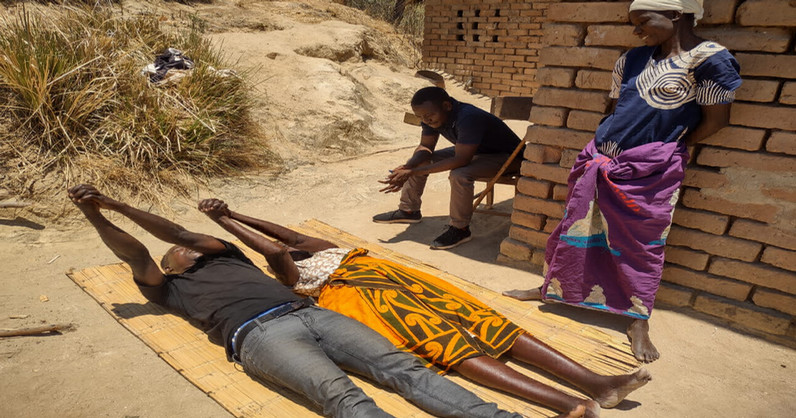
The siblings’ situation came to light when they were visited by Wisely, a volunteer with Health in Motion (HiM) https://healthinmotionafrica.com/, a local initiative that trains community volunteers to support the mobility and function of elderly people who are often confined to their homes. Wisely received formal training and certification through HiM, equipping him with the skills to safely assess mobility, guide exercise routines, and monitor physical progress. This training has given him confidence to move through his community with his new title as a “Movement Educator.”
As Abimbola (2019) reminds us, global health must shift its view from foreign observers to local actors. Health in Motion, a model developed over the past decade, reflects this shift by providing structured rehabilitation programs for functionable support in rural communities. These programs are available to be used by partner organizations and government initiatives to train local volunteers as movement educators, equipping them to deliver practical support within their own cultural and geographic context. By embedding these programs in the community, HiM fosters sustainability through locally led action rather than dependence on external interventions. Volunteers like Wisely serve as the mechanism through which change is enacted, translating training into practical support for elders and others in need.
HiM also developed a referral pathway with the District Hospital, allowing Wisely to seek physiotherapy input when needed or to refer more complex cases directly, and to coordinate with the palliative care team for elders needing medication support. These connections ensure that care extends beyond the home, creating a bridge between rural families and the formal health system.
Every two weeks, Wisely climbs the steep mountain to visit Janet and West, teaching them stretches and encouraging steady progress. Each visit brings smiles and anticipation. Slowly, their movements have improved; Janet now moves freely around her home, and West walks short distances to greet neighbours. Tasks once dependent on others - dressing, bathing, preparing meals - are now done independently.
Rather than repeating systems of dependency, Health in Motion represents a different way of working by returning knowledge, ownership, and decision-making to communities that have long been treated as recipients rather than shapers of health practice. It shows that decolonising health is not about rejecting global collaboration, but about restoring dignity, recognising and harnessing the capabilities already within communities, and nurturing locally grounded leadership that has too often been overlooked within formal health systems. By placing knowledge and program decisions back within community-owned structures, sustainable change begins to take root from within the community itself.
Health in Motion is more than a rehabilitation program; it is a bridge of hope, one that connects skill with compassion, and movement with meaning. In the hills of Northern Malawi, Janet and West stand as a testament to the fact that when one person regains movement, the entire household feels the change. The family’s burdens lighten, productivity improves, and dignity returns to daily living. Through this, Health in Motion truly embodies its vision; transforming life through movement, not only for those once limited, but for the families and communities who stand beside them.
References
Abimbola, S. (2019). The foreign gaze: Authorship in academic global health. BMJ Global Health, 4(5), e002068. https://doi.org/10.1136/bmjgh-2019-002068
Malawi National Statistical Office. (2018). Characteristics of older persons report (2018 Population & Housing Census). Zomba, Malawi: NSO.
Malawi24. (2020, December 8). Tonse govt plans to construct 900 health posts by 2022. https://malawi24.com/2020/12/08/tonse-govt-plans-to-construct-900-health-posts-by-2022/
Photo credit: Author